
New research suggests that in antiquity, sculpture was not just a visual or tactile experience. It was multi-sensory. Statues were painted, dressed, adorned and, in some cases, perfumed.
In a recent study published in the Oxford Journal of Archaeology, Cecilie Brøns, an archaeologist and curator at the Ny Carlsberg Glyptotek in Copenhagen, argues that scent played a significant role in the way people engaged with sculpture in the ancient Mediterranean world.
“The modern perception of ancient Greco-Roman sculpture is influenced by approximately two centuries of scholarly studies, which have focused almost exclusively on shape and form,” Brøns writes. This has created what she calls a kind of scholarly “smell-blindness,” that is, a failure to consider olfaction as part of the sculptural experience.
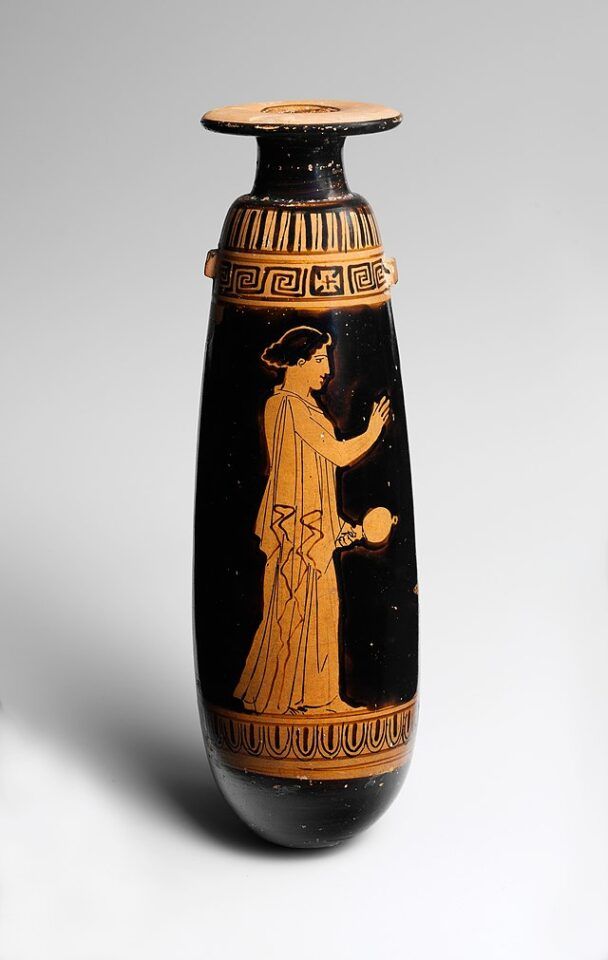
Ancient Greek Terracotta Alabastron (Perfume Vase), 440 BC/ Photo Credit: Wikimedia Commons
Brøns’ study is part of a broader movement known as the “sensorial turn” in classical studies. This approach encourages researchers to explore how the ancients engaged the full range of senses such as sight, sound, touch, taste, and smell, in their everyday environments, rituals, and artistic encounters. In this context, sculptures were not passive objects but dynamic presences, perceived and treated almost like living beings.
In antiquity, statues were regularly adorned through a process known as kosmesis—a ritual practice involving the application of clothing, jewelry, waxes, oils, and perfumes. A more elaborate, often festival-based version known as epikosmesis entailed ceremonial re-adornment. These rites could include anything from scented unguents to rose oil, linen wrappings, and garlands of fresh flowers. The result was a sculpture that not only appeared lifelike but smelled lifelike, bridging both the sacred and the sensual.
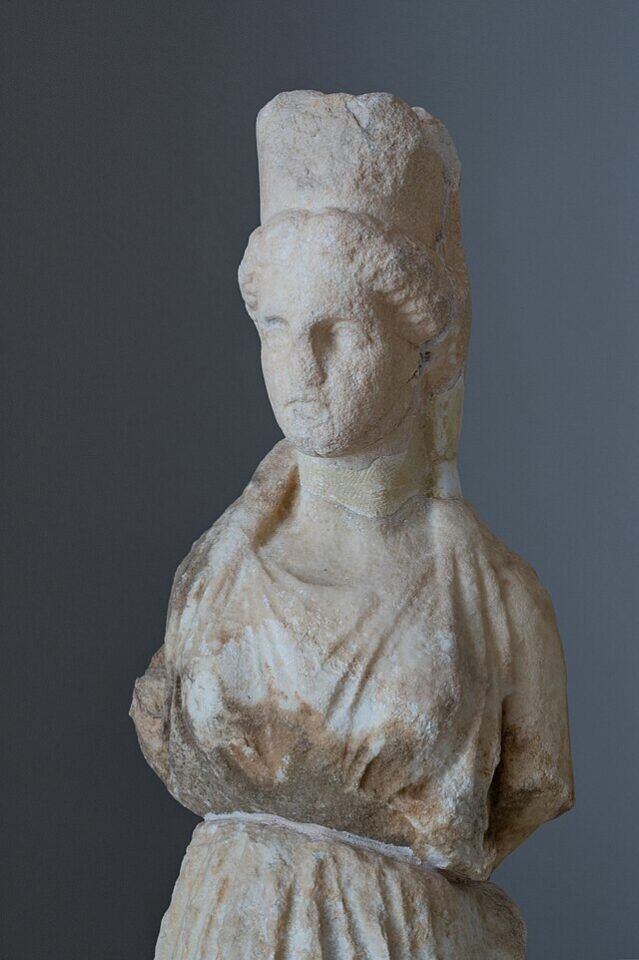
Statue of Artemis from sanctuary of Artemis in the Parian Delion. Around the year 360 BC. Parian marble. / Photo Credit Wikimedia Commons
Brøns’s paper presents a rich body of archaeological and epigraphic evidence—particularly from the sanctuary of Apollo on Delos. Inscriptions from the 4th to 2nd centuries BCE provide detailed inventories related to the maintenance of cult images. Several inscriptions record the use of rose perfumes, waxes, natron (a cleaning agent), sponges, and linen, used in the ritual care of statues of deities such as Artemis and Hera.
Two key Greek terms emerge in these inscriptions: myron, a thick, sweet-smelling perfumed oil often made from flowers like roses, and chrysma, a thinner, more affordable scented substance. Both were applied like balms rather than poured, and myron rhodion—rose oil—was among the most prized, also noted by Theophrastos as a light perfume especially suited for men.
In her paper, Brøns also discusses ganosis, a treatment involving the application of waxes and oils to maintain and shine statues. Plutarch and Pausanias reference the practice in the care of both anthropomorphic statues and aniconic cult images. At Delphi, for instance, a sacred stone believed to be the one Kronos swallowed in place of infant Zeus was “oiled daily” and dressed in unworked wool during festivals.
Cicero, writing in the 1st century BCE, criticized how the cult statue of Artemis in Segesta, Sicily, was ritually honored: “they anointed her with precious unguents… crowned her with chaplets and flowers… [and] attended her to the borders of their territory with frankincense and burning perfumes.”

Bust of Queen Berenike II of Egypt, in the Musee Royal de Mariemont, Belgium. / Photo Credit Romaine – Wikimedia Commons
The poet Kallimachos, writing of a newly made statue of Queen Berenice II of Egypt, remarked that it was “yet wet with perfume,” suggesting it had just undergone its initial kosmesis.
Even early Christian author Minucius Felix was reproached by Octavius for allowing their friend to “throw himself on stones, even though they are cut in the form of statues, anointed with perfumes and adorned with crowns.”
Floral adornment was another way scent was introduced to sculpture. Wreaths and garlands of aromatic plants were commonly draped over statues during religious events, adding both visual elegance and a fragrant presence. Brøns notes this as part of the multisensory environment of ancient sanctuaries and temples.
For Brøns, reintroducing scent into the study of sculpture can help reconstruct how ancient people encountered these objects, thus transforming them from lifeless marble forms into full-bodied presences that activated memory, emotion, and devotion.
And while the scents themselves have long since faded, Brøns notes that advances in scientific techniques such as gas chromatography-mass spectrometry (GC-MS) and proteomics offer promising tools for future studies. Though direct chemical evidence from sculptures is still lacking, residues like lipids and plant residues found in containers and sanctuaries are helping to recreate the formulas and ingredients of ancient perfumes.
Concluding, Brøns suggests that understanding ancient sculpture requires more than just engaging our eyes, but also “our imagination and knowledge about the olfactory dimensions and original sensory staging” of these sculptures. Only then can we appreciate how fully they can activate our senses, in a way similar to how ancient worshippers and audiences once encountered them.
Cover Photo of Diadoumenos / Photo Credit: Sailko – Wikipedia Commons














_MET_DP117203.jpg)

.JPG)
,_da_una_casa_a_delos,_100_dc_ca,_da_un_orig._di_policleto_del_450-425_ac_ca._02,_n._1826.jpg)